CNC Machining

At EMS Group we are suppliers and managers in the manufacture of machined metal parts and components for various industrial sectors. We offer comprehensive machining services ranging from turning to more complex processes such as turning, milling and drilling. Our experience and advanced technology allow us to work with materials such as steel, aluminum, forging and cast iron, meeting the most demanding quality and precision standards.
Requesting a CNC machining quote is easy: just upload your files with drawings, 3D models or sketches in any common format in our contact form.
What are the advantages of ordering CNC machined parts from EMS Group?
- Expand your production capacity.
- Consult with EMS Group engineers about your CNC machining project to find efficient and economical solutions.
- EMS Group takes care of the entire process, from quotation to delivery, including quality control.
- A single point of contact makes project management easier, allowing you to focus on tasks that add more value.
Machining processes
We carry out different types of machining processes:
- CNC Turning (2-Axis Lathes, Swiss Type Lathes)
- CNC Milling (3-, 4-, and 5-axis CNC machines)
- CNC Drilling (Vertical, Bench and Radial Drills)
- Turning

Material Selection
Choose from more than 30 metal and plastic materials:
- Aluminum alloys
- Stainless Steel
- Carbon Steel
- Titanium
- Brass
- Copper
- Rigid plastics (ABS, Acrylic, Polycarbonate, Peek, Polypropylene, POM, PTFE/Teflon, PVDF/Polyvinylidene Fluoride, UHMW PE/Ultra High Molecular Weight Polyethylene,
- ……
Delivery time
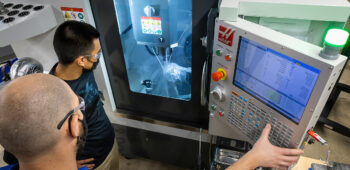
Using the most modern CNC turning machines, EMS Group produces high-precision parts manufactured at high speed in very short lead times.
Precision
EMS Group offers several tolerance options in accordance with ISO 2768 (standard, fine) and ISO 286 (grades 8, 7, 6).
Custom finishes
Select from a variety of finishes:
- Blasting: Bead blasting involves spraying a pressure jet of plastic or glass beads from a nozzle onto the surface of the part. This removes burrs and imperfections, leaving a smooth finish.
- Anodized (Type II): Type II anodizing provides increased corrosion resistance and can be used as a base for paint and other finishes. It consists of the use of dyes to modify the color of the surface of the piece. Type II coatings are susceptible to wear and tear and can discolor or fade in prolonged direct sunlight. Possibility to request custom colors (RAL).
- Anodized (Type III): Type III hard anodizing produces a thicker layer than standard anodizing, making it more durable and wear-resistant. It can be used as a base for paint and other finishes.
- Colors tend to darken slightly due to thickness. Anodized colors cannot correspond to specific Pantone or RAL colors.
- Powder coating: Provides a continuous, protective color finish on parts using evenly applied, heat-cured paint. The finish is usually stronger and more uniform than conventional paint. Metals such as aluminum and steel can be effectively coated with polymeric powders.
- Electrolytic Polishing: Electrochemical process that cleans steel parts to reduce corrosion and improve their appearance by increasing the shine of the metal.
- Passivation: Colorless coating that improves the corrosion resistance of the 200 and 300 series and precipitation-hardened corrosion-resistant steels by removing free iron from the surface.
- Chemical nickel plating: Chemical nickel plating provides a uniform nickel coating, offering protection against corrosion, oxidation, and wear on uneven surfaces.
- Zinc plated / Galvanized: Zinc plating consists of the electrodeposition of a thin layer of metallic zinc on the surface of another metal object, known as a substrate.
- Bluing (black oxide) : Black oxide is a type of conversion coating for ferrous materials, such as steel and stainless steel, that blackens the top layer of the material. It can be used to reduce reflections and glare, as well as to provide some additional corrosion resistance without affecting the dimensions of the parts.
- Gold Plating : The gold plating provides good corrosion and tarnish resistance. Gold has low contact strength, excellent conductivity and weldability.
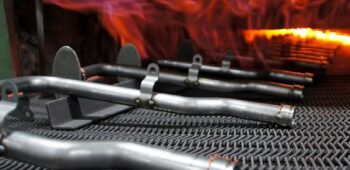
- Annealing: The annealing process involves heating a metal to or near the recrystallization temperature without changing the stresses. After heating, the metal is cooled to room temperature in the furnace or placed in sand.
- Cementing (carburizing): A heat treatment process that consists of hardening only the surface of the metal, without hardening the metal inside. As the name suggests, cementation involves inducing carbon or nitrogen in low-carbon alloys at elevated temperatures to increase their hardenability.
- Tempering: A heat treatment method that mainly consists of reducing the hardness of metals. It consists of heating the metal to a temperature below the critical point. The temperature is adjusted based on the amount of hardness that needs to be reduced and also varies depending on the type of metal.
- Deep tempering: Depth hardening differs from box hardening in that, rather than just the surface, the entire alloy is achieved to have relatively similar hardenability. This can be achieved by introducing carbon into the alloy matrix and repeatedly cooling it in brine or water. Oil quenching can also be used.
- Custom finishes: We can customize your finishes according to your needs.
Quality Control
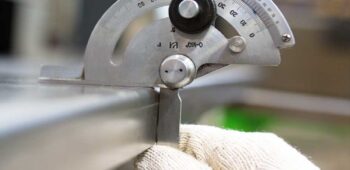
Our quality control department performs robust quality control. EMS Group is ISO 9001 certified.
Design Tips for CNC Machining
- Incorporate spokes on the inner edges. Since most cutting tools are cylindrical in shape, creating sharp internal edges can be tricky. It is advised that the internal radii be 130% of the radius of the milling tool.
- Avoid excessively thin walls. Thin parts tend to vibrate and warp due to the heat generated during the cutting process, which affects the tolerances that can be achieved.
- Specify tolerances only when they are essential. Tolerances that are too tight increase costs, as standard tolerances according to ISO 2768-m are applied if no other tolerances are specified.
Avoid designing features that are unnecessary or impossible to machine. This includes minute details that would require micromachining, a generally expensive but possible process.
- Cavities should maintain an adequate proportion between depth and width, ideally about four times the width of the cavity. Deeper cavities require larger diameter tools, resulting in larger radii at the inner edges.
- Limit the length of the threads. A length of three times the nominal thread diameter is usually sufficient to ensure robust connections in the first thread turns.
- Design holes with standard sizes so that conventional drill bits can be used. Holes with non-standard dimensions are treated as cavities and require milling tools for machining.
Frequently Asked Questions About CNC Machining
What is CNC Machining?
CNC (Computer Numerical Control) machining is a manufacturing process that uses computers to control machine tools. This system enables the precise and repetitive production of parts and components with complex geometries, using various materials such as metals, plastics and woods. Unlike traditional machining methods, where tools are operated manually, CNC machining relies on computer programs that dictate to the machine what to do, resulting in greater accuracy and efficiency.
The process begins with the design of the part through 3D modeling software, such as CAD (Computer Aided Design). From this design, codes are generated in G language, which are instructions that the CNC machine will follow to perform cutting, milling, drilling and other machining processes. These machines can be milling machines, lathes, laser cutters, among others, and are equipped with tools that can change automatically as needed by the program.
The movement of CNC machines can be defined by their axes; these are X, Y and Z with A, B and C axes for more advanced machines. The X, Y, Z axes refer to the main Cartesian vectors and the A, B, C axes refer to the rotation on these axes. CNC machines typically operate with up to 5 axes.
How to Decrease the Cost of CNC Machined Parts?
- The cost of CNC-manufactured parts depends on four main elements: machining time, material choice, initial costs, and part shape.
- To minimize expenses and ensure the production of your CNC parts, follow our design recommendations for CNC machining. We advise you to try different versions of your design to see how slight modifications can influence the price. In addition, as the number of parts ordered increases, the cost per unit decreases considerably, as the configuration costs are incurred only once.
- The material used to manufacture the parts is another essential factor in the total cost. Beyond the price of the material, those with low machinability require more time and resources for machining, including cutting tools and lubricants. That’s why it’s crucial to make an informed choice when selecting the material for your custom parts.
Do you offer manufacturing consulting?
- Yes, our customers can count on the professional guidance of our manufacturing engineers, who have extensive experience to help them identify the most suitable and economical option to produce their parts.
Are turning and milling for plastics available?
- The selection of materials includes metals and plastics, including steel, stainless steel, aluminum, titanium, PE, POM, etc.
Are there 5-axis CNC milling machines available?
Yes, EMS Group has access to a wide range of CNC machines with various capabilities.
What is the quality of CNC machined parts?
We follow ISO 9001 quality management system standards, ensuring that your work meets specific quality standards. EMS Group’s quality engineers add an extra level of safety to the process.
Order CNC Machined Parts Now